A TikTok Shop that starts as one person's side project can quickly become a full-time operation needing several specialist skills. Creator outreach, content production, editing, LIVE hosting, ads, operations and customer service each require different strengths. Knowing which roles exist, what they do and when to hire them helps you build a team that scales without chaos.
This guide describes the core roles in a TikTok Shop team, the skills to look for and a typical hiring order. Small teams combine roles; larger teams split them further.
1. TikTok Shop Manager or Lead
What they do: own the shop's strategy and results, set priorities, coordinate other roles, manage the calendar and report on performance.
Skills: ecommerce experience, understanding of TikTok's ecosystem, data literacy, organisation and communication.
In early stages, the founder often fills this role. As the team grows, a dedicated lead keeps everyone aligned.
2. Creator and Affiliate Manager
What they do: find, recruit and manage creators, approve samples, write briefs, negotiate deals, track performance and nurture relationships.
Skills: relationship building, persuasive writing, organisation, negotiation and an eye for content that sells.
Because creators drive much of TikTok Shop revenue, this is often the first dedicated hire. See our guides to the affiliate program and finding creators.
3. Content Producer or Strategist
What they do: plan content, write hooks and scripts, film brand videos, manage the content calendar and coordinate UGC.
Skills: creativity, understanding of TikTok trends and formats, scriptwriting and basic filming.
Our guides to content calendars and scripts describe the work.
4. Video Editor
What they do: edit brand and creator footage into finished videos, create variations for testing and ads and maintain templates.
Skills: fast, platform-native editing, captioning, pacing and attention to detail. See our editing guide.
5. LIVE Host and Producer
What they do: hosts present products on LIVE; producers manage run-of-show, offers and technical setup.
Skills: hosts need energy, product knowledge and selling ability; producers need organisation and technical confidence. See our guide to hiring LIVE hosts.
6. Ads Specialist
What they do: run TikTok Shop and website ad campaigns, manage budgets, test creative and report on returns.
Skills: paid social experience, analytical thinking and understanding of creative testing. See our ads guide.
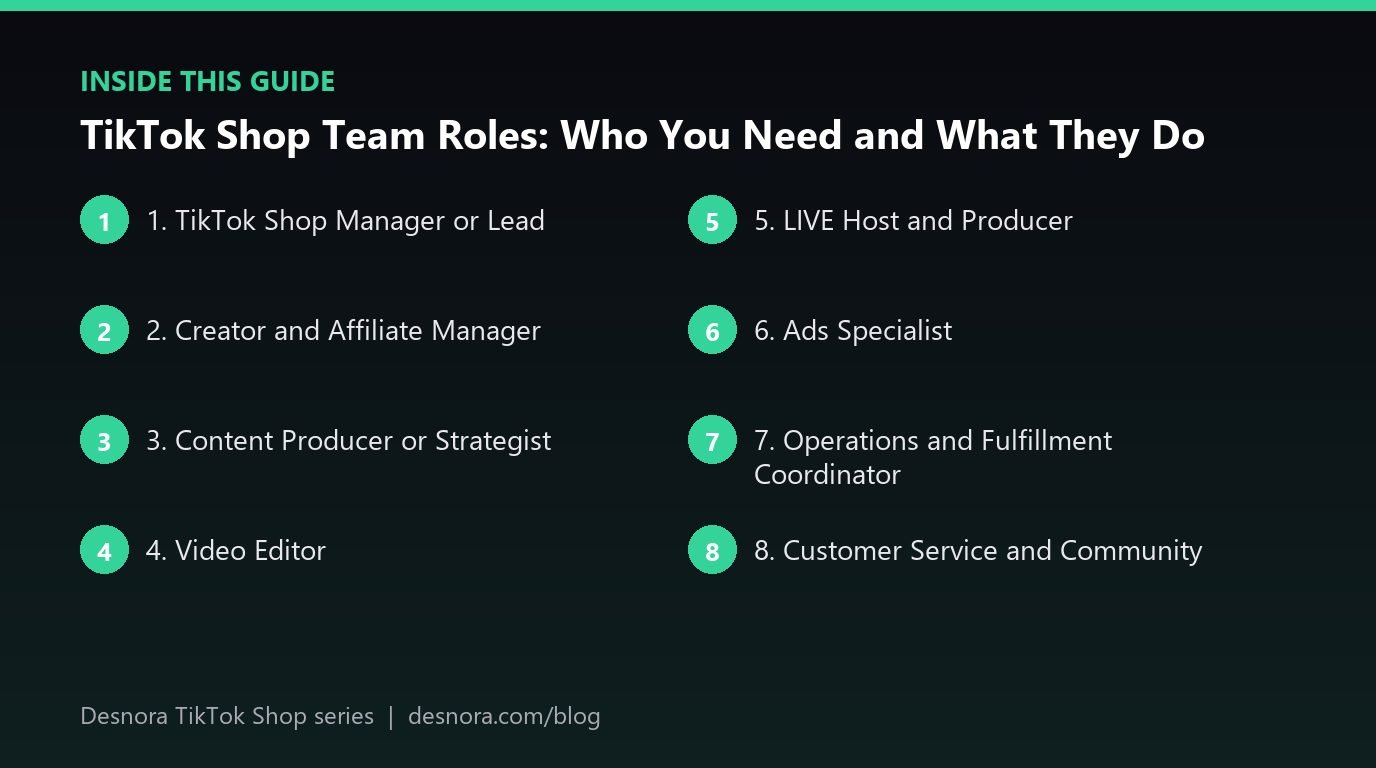
7. Operations and Fulfillment Coordinator
What they do: manage inventory, fulfillment partners, integrations, shipping performance and returns.
Skills: organisation, problem solving and comfort with systems and data. See our guides to fulfillment and inventory.
8. Customer Service and Community
What they do: answer buyer messages, handle returns and refunds, moderate comments and manage community engagement.
Skills: empathy, clear writing, policy knowledge and calm under pressure. See our customer service templates and comment management guide.
9. Compliance and Account Health
What they do: monitor account health, review listings and creator content for compliance, manage category approvals and appeals.
In small teams, this is usually part of the shop manager's or operations role. See our account health guide.
10. Analyst
What they do: build reports, track metrics, analyse tests and support decisions with data.
Larger teams benefit from a dedicated analyst; smaller teams share this work. See our analytics guide.
A Typical Hiring Order
- Founder covers most roles, with freelance editing help.
- First hire: creator and affiliate manager, often combined with content coordination.
- Second: content producer or editor to increase output.
- Third: customer service and operations support as order volume grows.
- Fourth: ads specialist once creative supply and proven products exist.
- Fifth: LIVE host and producer for a regular LIVE schedule.
- Later: dedicated shop lead, analyst and compliance specialists.
Your order may differ depending on strengths, category and whether you use agencies. Our guide to agency vs in-house explains hybrid models.
Freelancers and Part-Time Roles
Many roles work well part-time or freelance early on, especially editing, LIVE hosting and customer service cover. Freelancers provide flexibility while you learn what you need. Document processes so freelancers can step in easily.
Writing Clear Job Descriptions
Define outcomes, not just tasks. For a creator manager, outcomes might include creators activated per month, sample posting rate and GMV from affiliates. Clear outcomes help candidates understand the role and make performance reviews fair.
Combining Roles in Small Teams
In a team of two or three, roles must be combined sensibly. Common pairings include creator management with content coordination, editing with brand filming, and customer service with operations. Pair roles that share skills and rhythms. Avoid giving one person both high-volume support and strategic planning, since urgent messages crowd out longer-term work.
Skills to Look For Across Roles
Whatever the role, TikTok Shop team members benefit from genuine familiarity with TikTok as users, comfort with data, speed and adaptability, clear communication and good judgement on compliance. Ask candidates to share TikTok content they admire and explain why it works. Their answers reveal how well they understand the platform.
Practical Hiring Tests
Short, paid tasks reveal more than interviews. Ask a creator manager candidate to write outreach messages for three creators, an editor to cut a short video from raw footage or a content producer to propose five hooks for a product. Evaluate quality, speed and judgement. Keep tasks short and fair to respect candidates' time.
Onboarding New Team Members
Good onboarding speeds up results. Share brand guidelines, product information, claims guides, creator lists, content libraries and reporting templates. Pair new hires with someone experienced for their first weeks and set clear goals for the first 30, 60 and 90 days. Our content calendar and analytics guides make useful onboarding material.
Working Rhythms
A TikTok Shop team needs regular touchpoints: a short weekly planning meeting, a weekly performance review and daily check-ins during campaigns and launches. Shared calendars and dashboards keep everyone aligned without endless meetings.
Team Culture
TikTok rewards speed, experimentation and authenticity. Encourage testing, celebrate learnings as well as wins and keep the team close to customers by sharing comments and reviews. A team that enjoys the platform produces better content than one that treats it as a chore.
Remote and Distributed Teams
Many TikTok Shop roles work remotely, but some, such as filming and LIVE hosting, benefit from a physical studio. Plan which roles need in-person time and equip remote team members with clear processes, shared tools and regular communication.
Measuring Each Role
Give every role a small set of measurable outcomes. A creator manager might be measured on creators activated, sample posting rate and affiliate GMV. A content producer on videos published and retention. An ads specialist on return on ad spend and creative tested. Operations on dispatch performance and stock accuracy. Customer service on response time and resolution. Clear measures make performance conversations fair and help the team see how each role contributes.
Common Hiring Mistakes
- Hiring generalists for highly specialised work, or vice versa.
- No clear owner for results.
- Hiring ads specialists before content supply exists.
- Overlooking customer service until problems pile up.
- No documentation, so knowledge leaves with people.
Team Roles Checklist
- Map current tasks and who covers them.
- Identify the biggest bottleneck.
- Hire or outsource for that bottleneck first.
- Define outcomes for each role.
- Document processes and handovers.
- Review the structure as the shop grows.
Desnora provides specialist TikTok Shop roles as a managed team, or alongside your in-house staff. Explore our TikTok Shop services or contact us.
Frequently Asked Questions
What roles does a TikTok Shop team need?
Typically a shop lead, creator manager, content producer, editor, LIVE host and producer, ads specialist, operations coordinator and customer service.
Who should a TikTok Shop brand hire first?
Often a creator and affiliate manager, since creators drive much of TikTok Shop revenue, sometimes combined with content coordination.
Can one person run a TikTok Shop?
Early on, yes, often with freelance help. As volume grows, specialist roles become necessary.
When should I hire an ads specialist?
Once you have proven products and enough creative supply for ads to scale effectively.
Can TikTok Shop roles be freelance?
Many can, especially editing, LIVE hosting and customer service cover, particularly in early stages.
Who handles compliance in a small team?
Usually the shop manager or operations coordinator, supported by clear processes and checklists.
How do I write a good job description for TikTok Shop roles?
Define the outcomes you expect, such as creators activated or content output, as well as tasks and required skills.
What is the biggest team-building mistake?
Not having a clear owner for results, or hiring for the wrong bottleneck first.
Should I use an agency instead of hiring?
Many brands combine both, using agencies for some functions while building an internal team for others.
How do I keep knowledge when people leave?
Document processes, briefs, creator lists and learnings in shared systems the business owns.
How should small teams combine TikTok Shop roles?
Pair roles with similar skills and rhythms, such as creator management with content coordination, and avoid mixing urgent support with strategic planning.
How should I measure TikTok Shop team members?
Give each role a few clear outcomes, such as creators activated, videos published, return on ad spend, dispatch performance or response time.
Do TikTok Shop teams need to be in an office?
Many roles work remotely, but filming and LIVE hosting benefit from a physical studio, so plan in-person time where needed.