A shoppable video has a narrow window to work. It has to stop the scroll, earn attention, prove the product is worth buying and prompt a tap on the product link, often in well under a minute. Creativity matters, but structure matters more. The videos that consistently sell on TikTok Shop tend to follow a handful of repeatable patterns.
This article breaks down seven script frameworks we use for brand videos and creator briefs, with examples you can adapt. Use them as starting points, not rigid templates. The best results come when a creator takes a proven structure and delivers it in their own voice.
The Anatomy of a Shoppable Video
Almost every converting TikTok Shop video contains four elements, even if they appear in different orders:
- Hook: the first second or two that makes a viewer stop scrolling. Our dedicated guide to TikTok Shop hooks covers this in depth.
- Problem or desire: the situation the viewer recognises, such as a frustration, a goal or a moment of curiosity.
- Demonstration and proof: the product in action, showing that it works.
- Call to action: a clear prompt to tap the product link, often with a reason to act now.
Keep this anatomy in mind as you read the frameworks below. Each one arranges these elements differently to suit a particular product or angle.
Framework 1: Problem, Agitate, Solve
This classic structure works for any product that fixes a common frustration.
- Problem: "If your hair is always frizzy by lunchtime..."
- Agitate: show the frustration, such as frizz after leaving the house, wasted products and morning routines that do not last.
- Solve: introduce the product, demonstrate it and show the result later in the day.
- CTA: "It's in the orange basket below, and it's on offer this week."
The key is making the problem feel specific and familiar. Generic problems produce generic engagement.
Framework 2: The Satisfying Demo
Some products sell themselves when people simply see them working. Cleaning tools, kitchen gadgets, organisers and beauty devices often fit here.
- Hook: open on the most satisfying moment, such as a stain disappearing or a perfect slice.
- Demo: show the full process with minimal talking, using close-ups and natural sound.
- Reveal: the final result, ideally side by side with the starting point.
- CTA: a short on-screen text prompt or voiceover pointing to the product link.
Satisfying demos are highly rewatchable, which helps distribution. Keep them tight and visually clear.
Framework 3: Honest Review
Reviews feel trustworthy because they mimic a friend's recommendation.
- Hook: "I've used this for two weeks. Here's my honest opinion."
- Context: why the creator tried it and what they expected.
- Pros: the two or three things they genuinely love, with demonstration.
- Caveat: a small, honest limitation or tip, which increases credibility.
- Verdict and CTA: whether they would buy again and where to get it.
Encourage creators to be honest. Over-polished praise reads as an advert, while balanced reviews often convert better.
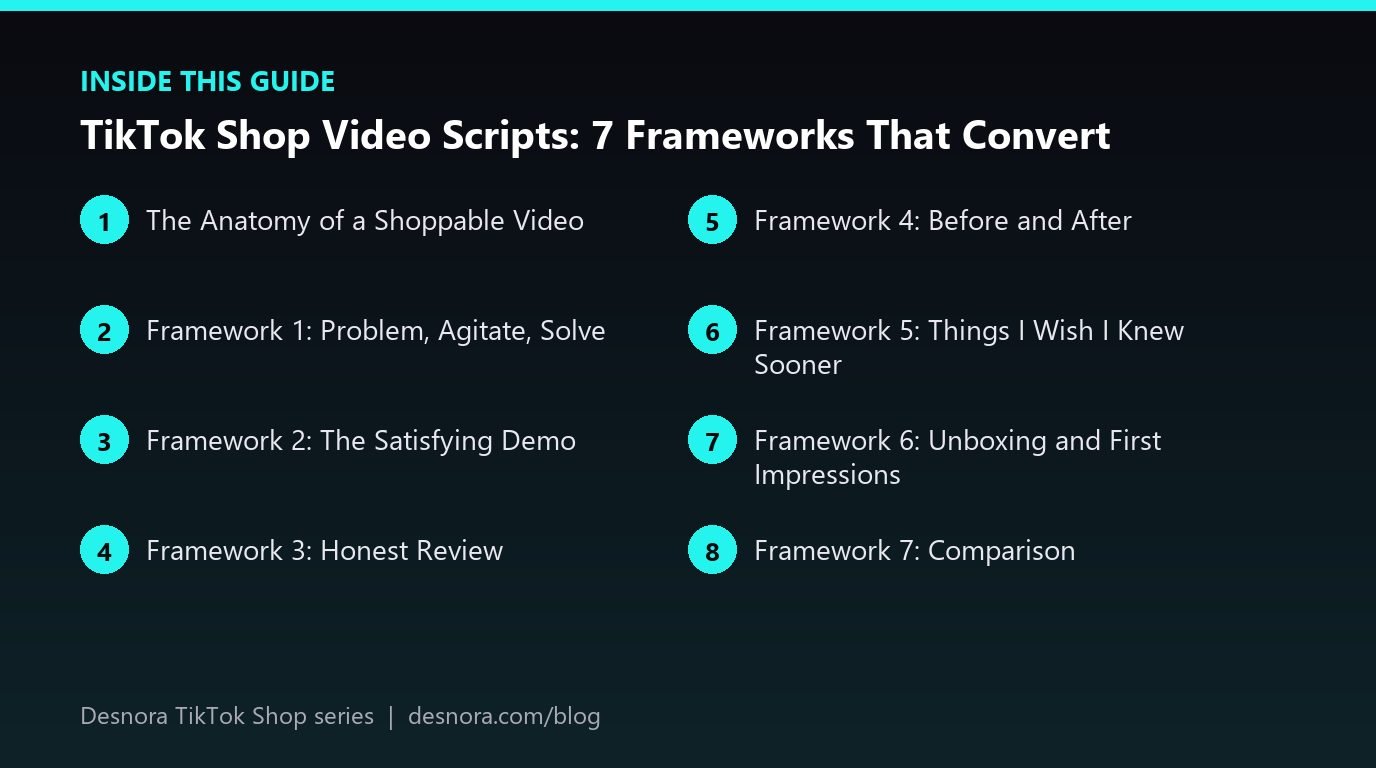
Framework 4: Before and After
Transformation is compelling, but be careful: before-and-after claims are restricted in some categories, particularly health and beauty. Where permitted, keep it realistic and honest.
- Hook: show the "after" first to create curiosity.
- Rewind: show the "before" state.
- Process: how the product was used.
- Result and CTA: return to the after, then point to the product.
For home and organisation products, before and after works especially well and carries less compliance risk.
Framework 5: Things I Wish I Knew Sooner
List-style videos hold attention because viewers wait for each item.
- Hook: "Three things that made my mornings so much easier."
- Items: two quick, genuinely useful tips or products, followed by your product as the strongest item.
- Payoff: why this product made the biggest difference.
- CTA: point to the product link.
This framework works well for creators who want content that feels educational rather than promotional.
Framework 6: Unboxing and First Impressions
Unboxings tap into curiosity and anticipation.
- Hook: "I finally got the one everyone keeps talking about."
- Unbox: show packaging and contents, highlighting quality details.
- First use: try the product on camera and react genuinely.
- CTA: share the current offer and link.
Good packaging helps here, which is why our free samples strategy recommends making the sample box camera-ready.
Framework 7: Comparison
Comparisons help shoppers decide, especially for considered purchases.
- Hook: "Expensive version vs this one. Can you tell the difference?"
- Test: put both products through the same test on camera.
- Result: show the outcome clearly.
- CTA: highlight the value and link.
Avoid naming or disparaging competitors directly in ways that could create legal or policy issues. Comparisons with "my old one" or generic alternatives are safer.
Brand Account Scripts vs Creator Scripts
Videos posted from your brand account and videos posted by creators play different roles, and the scripts should reflect that. On a creator's account, the viewer already has a relationship with the person on screen. The script can lean on personal experience, humour and the creator's established style. Viewers trust the recommendation because they trust the creator.
On a brand account, that trust has to be earned within the video itself. Brand scripts work best when they feel like content rather than adverts: educational demonstrations, behind-the-scenes looks at how the product is made, founder stories, or team members using the product in real situations. Featuring a consistent on-screen personality, such as a founder or team member, helps the brand account build the same familiarity that creators enjoy.
Both types of content are valuable. Brand videos give you creative you fully control and can use freely in ads, while creator videos bring reach and authenticity that brand content rarely matches.
Turning One Script Into Many Videos
Volume matters on TikTok Shop, and a single strong script can produce many videos. Film the same framework with different hooks, different on-screen personalities, different settings and different product variants. A problem-agitate-solve script for a portable blender could become a gym version, an office version, a travelling parent version and a student dorm version, each speaking to a different audience.
Record extra B-roll during every shoot: close-ups of the product, hands-on demonstrations, reaction shots and the final result. With a library of clips, editors can assemble new variations quickly without reshooting, keeping your content pipeline full while you learn which combinations perform best.
Writing the Call to Action
A strong CTA is specific and gives a reason to act now. Rather than "check it out", try "tap the orange basket, it's on offer until Sunday" or "grab it below before the bundle sells out". Combine a spoken CTA with on-screen text, since many viewers watch with sound off. Make sure any offer mentioned is genuinely active, as false urgency can create policy issues and erode trust.
Length, Pacing and Editing
There is no perfect length. Short videos of fifteen to thirty seconds work well for simple products and satisfying demos. Products that need explanation can sustain longer videos if every second earns its place. Pacing is more important than duration: cut pauses, use jump cuts, add captions and change the shot every few seconds to maintain momentum.
Captions are essential. Many viewers watch without sound, and captions also help retention for those listening. Use TikTok's native text and caption tools for a platform-native look.
Testing Scripts Systematically
The fastest way to find winning scripts is to test variations. Keep the product and demonstration constant and change one element at a time, such as the hook, the problem framing or the CTA. Post several versions and compare view-through rate, product clicks and orders. Once a framework proves itself, brief creators on it and promote the best versions with ads, as our ads guide explains.
Keep a library of your best-performing videos with notes on why they worked. Over time this becomes a playbook that speeds up production and improves creator briefs.
Compliance Reminders
Scripts must follow TikTok's commerce and community policies. Avoid medical claims, exaggerated results, misleading pricing and content that implies endorsements you do not have. Make sure creators include required disclosures. When in doubt, describe what the product does and how people use it rather than promising outcomes.
Desnora writes scripts, briefs creators and produces shoppable video content for brands. Explore our TikTok Shop content services, or if you also sell on Amazon, our brand story and premium A+ content work keeps your messaging consistent. Get in touch to discuss your content plan.
Frequently Asked Questions
How long should a TikTok Shop video be?
Many converting videos run fifteen to forty-five seconds, but the right length depends on the product. Simple products suit short demos, while products needing explanation can sustain longer videos with tight pacing.
Should I give creators a full script?
Give creators a framework, key benefits and proven hooks rather than a word-for-word script. Content performs best when creators deliver it in their own voice.
What is the best call to action for TikTok Shop videos?
Be specific and give a reason to act, such as "tap the orange basket below while the bundle offer is on". Combine spoken and on-screen CTAs for viewers watching without sound.
Can I use before-and-after videos on TikTok Shop?
It depends on the category. Before-and-after content is restricted for some health and beauty claims, so check category policies and keep results realistic and honest.
How do I know which script framework works best?
Test several frameworks for the same product, changing one element at a time, and compare view-through rate, product clicks and orders to identify winners.