Every TikTok Shop goes through recognisable stages. The first sales feel like a breakthrough. Then come the challenges of consistency, then scale, then complexity. What works at one stage can hold you back at the next: a founder doing everything is perfect at the start and a bottleneck later; a scrappy spreadsheet is fine for ten creators and chaos for three hundred.
This roadmap describes four stages of TikTok Shop growth, the priorities at each one and the signs that you are ready to move on. Revenue figures are deliberately left out, because the thresholds vary so much by category, price point and margin. Focus instead on the characteristics of each stage.
Stage 1: Proving the Product
What it looks like: the shop is set up, a few products are listed and early sales come from a handful of videos and creators. Sales are irregular.
Priorities:
- Set up correctly and keep account health clean. See our setup guide.
- Find one or two hero products that clearly resonate.
- Test many hooks and angles on your brand account.
- Seed a steady stream of creators to discover who sells.
- Understand your true unit economics using our fees guide.
Team: usually the founder or one dedicated person, possibly with freelance help.
Ready to move on when: at least one product sells consistently through several creators and videos, not just one viral moment.
Stage 2: Building Consistency
What it looks like: sales are steadier, a group of creators posts regularly and some content reliably converts. The challenge becomes keeping the engine running every week.
Priorities:
- Build weekly rhythms for content, creator outreach and reporting.
- Formalise the affiliate program with briefs, tiers and sample criteria. See our affiliate guide.
- Start ads behind proven creative. See our ads guide.
- Launch a regular LIVE schedule.
- Strengthen fulfillment so spikes do not break operations.
Team: a small team or agency support covering creators, content and operations.
Ready to move on when: growth comes from repeatable processes rather than individual effort, and the shop can handle spikes without missing standards.
Stage 3: Scaling
What it looks like: the shop grows quickly across several products, creators number in the dozens or hundreds, ad spend is significant and LIVE is a meaningful channel. Complexity rises sharply.
Priorities:
- Expand the catalog with complementary products and line extensions.
- Scale creator recruitment with systems, CRM and specialised roles.
- Build a content production pipeline for ads and organic.
- Professionalise inventory forecasting and cash management. See our guides to inventory and cash flow.
- Protect the brand from copycats. See our brand protection guide.
- Develop retention and repeat purchase strategies.
Team: specialists in creator management, content production, ads, LIVE, operations and customer service, in-house or through partners.
Ready to move on when: TikTok Shop is a stable, profitable channel and the business is looking for new growth vectors.
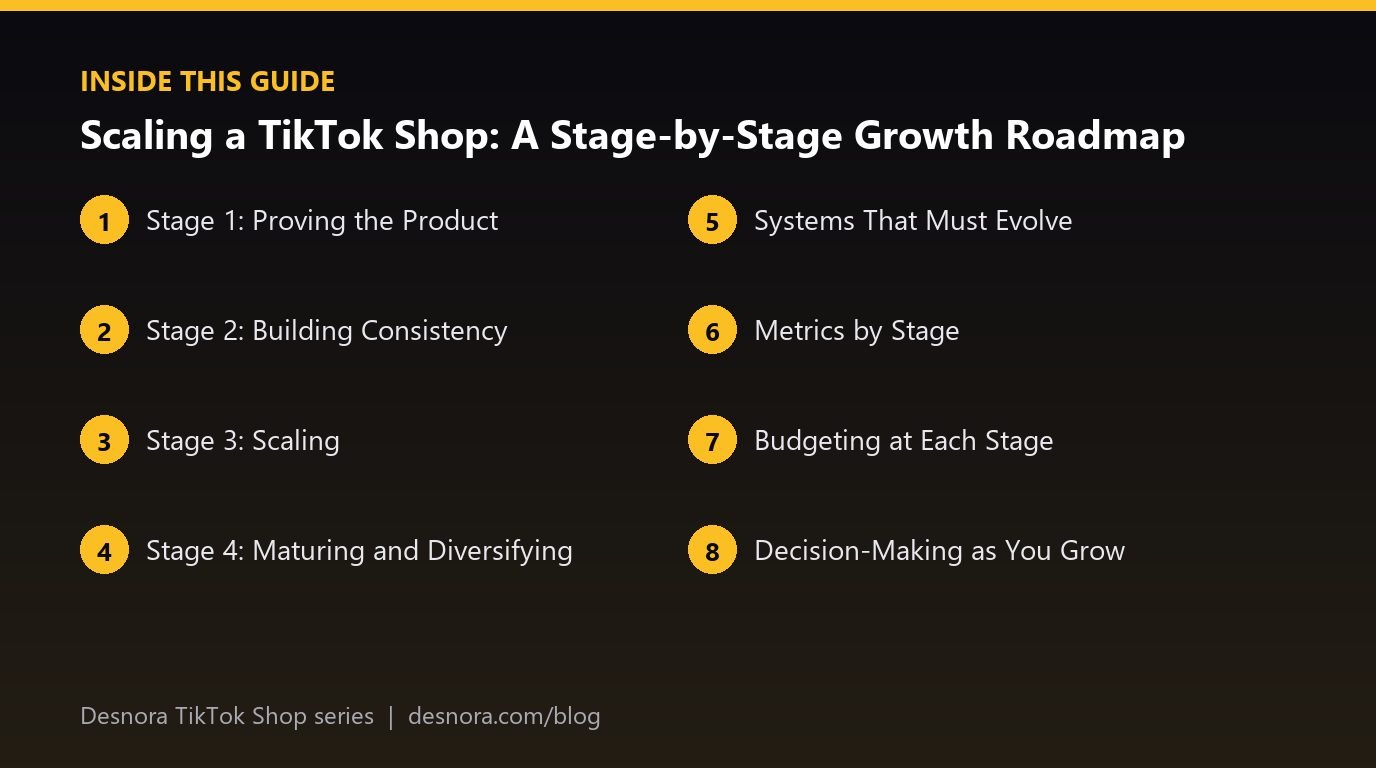
Stage 4: Maturing and Diversifying
What it looks like: TikTok Shop is a core channel within a multi-channel business. Growth comes from new markets, new categories and deeper customer relationships.
Priorities:
- Expand into new countries. See our international expansion guide.
- Integrate TikTok with Amazon, DTC and retail strategies.
- Measure TikTok's halo effect on other channels. See our halo effect guide.
- Build brand equity beyond individual products.
- Optimise margins and operational efficiency.
Team: a dedicated social commerce function with leadership, specialists and analytics.
Systems That Must Evolve
As you scale, upgrade systems before they break:
- Creator management: from inbox and spreadsheet to a structured CRM with tiers and tracking.
- Content: from ad hoc filming to a calendar and production pipeline. See our content calendar guide.
- Inventory: from gut feel to forecasting with leading indicators.
- Reporting: from dashboard checks to weekly reports with clear actions.
- Customer service: from founder replies to templates, coverage rotas and helpdesk tools.
- Finance: from occasional checks to monthly reconciliation and cash forecasting.
Metrics by Stage
The most important metrics shift as you grow:
- Stage 1: product click-through, conversion, content that sells, unit economics.
- Stage 2: active creators, weekly content volume, ad return, dispatch performance.
- Stage 3: contribution margin, inventory cover, cash runway, repeat purchase rate.
- Stage 4: market-level profitability, multi-channel impact, brand search growth.
Our analytics guide explains how to report on them.
Budgeting at Each Stage
Spending priorities shift as you grow. In the first stage, most money goes to inventory, samples and a basic filming setup, with commissions paid only on sales. In the consistency stage, ads and LIVE production take a larger share, along with your first hires or agency support. In the scaling stage, inventory and cash reserves become the largest commitments, alongside specialised team members and tools. In the mature stage, investment moves toward new markets, brand building and systems. Reviewing budget allocation against your current stage prevents both under-investing in what matters now and over-investing in things you are not ready for.
Decision-Making as You Grow
Early on, the founder makes every decision quickly. As the shop scales, that becomes impossible. Define who owns which decisions: creator commissions, ad budgets, promotions, product launches and inventory orders. Set guardrails, such as maximum discount levels or ad budget ranges, so team members can act without waiting for approval. Clear ownership keeps the speed that made the shop successful while reducing the risk of costly mistakes.
When Growth Stalls
Most shops hit plateaus. When growth stalls, look at leading indicators first: are fewer creators posting, is content volume down, are ads fatigued, are product pages converting less, or are operational metrics slipping? Plateaus usually trace back to one or two weak links. Fixing them, rather than adding new initiatives, is often the fastest route back to growth. Our common mistakes guide lists the usual culprits.
Common Scaling Traps
- Scaling ads before content supply: ad performance falls as creative fatigues.
- Growing faster than operations: late shipments and cancellations damage account health.
- Running out of cash: inventory funding outpaces payouts.
- Depending on one creator or product: a single change can halve sales.
- Founder bottlenecks: every decision waits for one person.
- Losing the brand: chasing trends erodes what made customers love you.
Diversifying Risk
A healthy, scaling shop spreads risk across products, creators, content sources and channels. Watch concentration: if one creator or one video drives a large share of sales, invest in building alternatives. If one product dominates, develop complementary products. Diversification makes growth more durable.
Keeping Account Health Strong at Scale
More orders, creators and content mean more chances for policy issues. Scale compliance processes alongside growth: claims guides, creator content checks, listing reviews and weekly account health monitoring. A serious violation at scale is far more costly than at the start. Our account health guide explains what to monitor.
Leadership and Culture
As the team grows, culture matters. TikTok rewards speed, experimentation and authenticity. Encourage testing, share learnings openly, celebrate wins and analyse failures without blame. Keep the team close to customers by sharing comments, reviews and messages. Brands that stay curious and close to their audience keep finding new growth.
Roadmap Checklist
- Identify your current stage honestly.
- Focus on that stage's priorities.
- Upgrade systems before they break.
- Track the metrics that matter for your stage.
- Watch for concentration risk.
- Scale compliance with growth.
Desnora supports brands at every stage of TikTok Shop growth, from launch to multi-market scale. Explore our TikTok Shop services, see our case studies or book a strategy call.
Frequently Asked Questions
What are the stages of TikTok Shop growth?
Proving the product, building consistency, scaling and maturing into a diversified, multi-channel business.
When should I start running TikTok Shop ads?
Usually in the consistency stage, once you have proven content and products that convert organically or through creators.
What is the biggest risk when scaling a TikTok Shop?
Common risks include operations failing under volume, running out of cash for inventory, creative fatigue and depending on a single creator or product.
When should I hire a team for TikTok Shop?
Add help when founder time becomes the bottleneck, typically as you move from proving the product to building consistency.
How do I know which stage my shop is in?
Look at how consistent sales are, how many creators and products drive them, how repeatable your processes are and how stable operations feel during spikes.
Should I expand to new markets early?
Usually not. International expansion fits the mature stage, after TikTok Shop is stable and profitable in your home market.
How do systems need to change as I scale?
Move from inboxes and spreadsheets to structured creator CRMs, content calendars, forecasting, weekly reporting, support tools and monthly financial reconciliation.
How can I reduce dependence on one viral product?
Develop complementary products and line extensions, broaden your creator base and build content across several products so no single item carries the shop.
What should I do when TikTok Shop growth stalls?
Check leading indicators first, such as creator activity, content volume, ad fatigue, conversion and operational metrics, then fix the weakest link before adding new initiatives.
How should budgets change as a TikTok Shop grows?
Early budgets focus on inventory, samples and filming basics; later stages shift toward ads, LIVE, team, inventory reserves and eventually new markets and brand building.