Every TikTok Shop brand eventually asks the same question: where do we find creators who actually sell? Follower counts are easy to see but tell you surprisingly little. Some creators with millions of followers drive almost no purchases, while others with a few thousand followers sell out products in a weekend. The difference comes down to audience trust, content style and fit with your product.
This guide lays out a practical, repeatable system for finding, vetting and recruiting creators for TikTok Shop, based on the process we use when running affiliate programs for brands.
Define Your Ideal Creator First
Before you search, describe the creator you want. Start with your customer: who buys your product, what problems do they have, what content do they already watch? Then work backwards to the creators who serve that audience. A kitchen gadget brand might target home cooks, busy parents and meal-prep creators. A skincare brand might target skincare enthusiasts, makeup artists and wellness creators.
Write down three to five creator profiles with their typical niche, content style and audience. This keeps your search focused and helps anyone on your team judge whether a creator is a good fit.
Where to Find Creators
There are several reliable sources, and the best programs use all of them.
- Affiliate marketplace in Seller Center: TikTok's built-in tools let you search for creators by category, follower range and sales performance, and send collaboration invites directly.
- Competitor products: look at who is promoting similar products. Creators already selling in your category know how to present it and have audiences that buy.
- Hashtags and search: search niche keywords and hashtags related to your product and note creators whose videos have strong engagement and shopping links.
- Your own comments and customers: people who comment enthusiastically on your videos or tag you in their content are often natural advocates.
- Creator agencies and networks: useful for reaching established creators quickly, though usually at a higher cost.
Metrics That Predict Sales
When vetting a creator, look beyond follower count. The most useful signals are:
- Average views on recent videos: what a typical video achieves, not the single viral outlier.
- Engagement quality: comments asking where to buy, how it works or whether it is worth it indicate purchase intent.
- Shopping history: whether the creator already makes shoppable videos and how their content performs with products similar to yours.
- Posting consistency: creators who post regularly are more likely to deliver content on time.
- Audience fit: does the audience look like your customer in age, interests and location?
TikTok's creator tools often show sales-related data such as GMV ranges or units sold for affiliate creators. Use this as a strong signal, but combine it with your own review of their content.
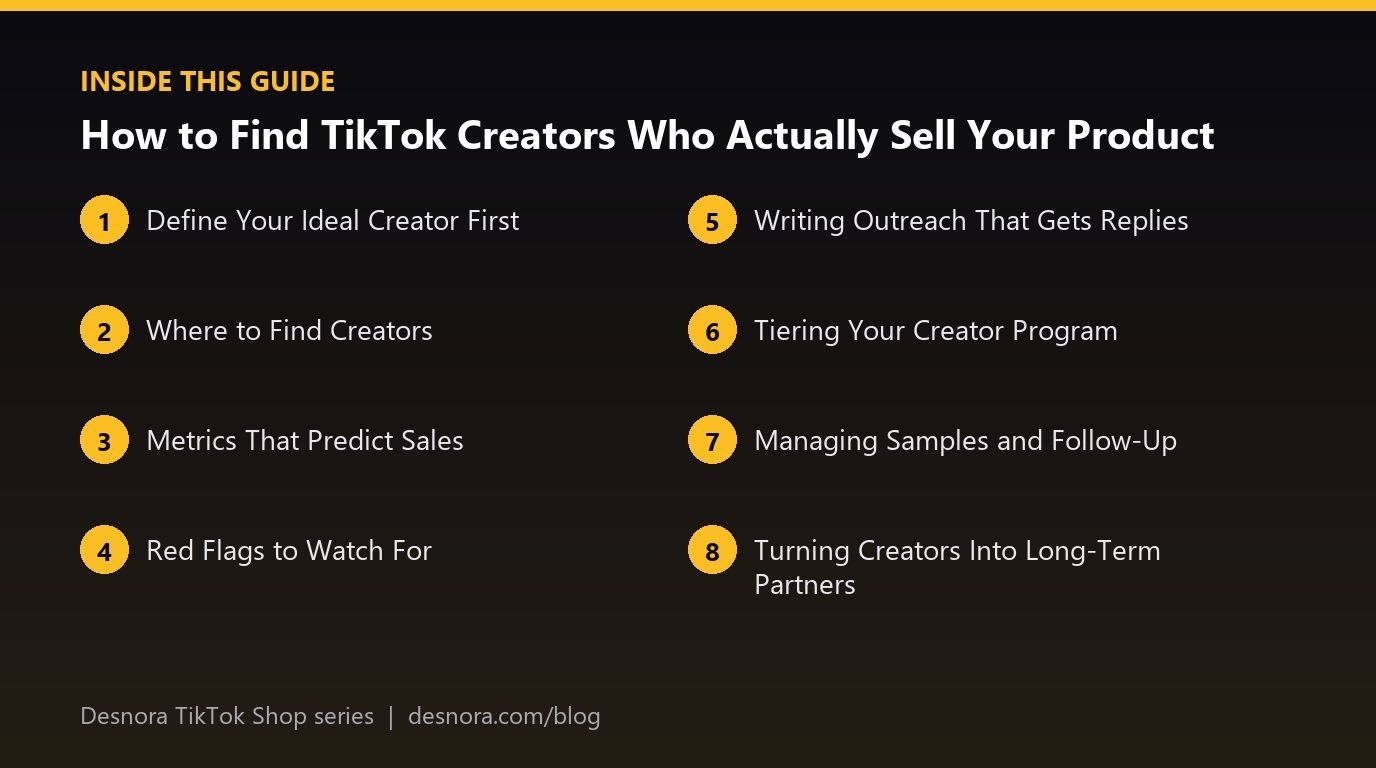
Red Flags to Watch For
Some creators look strong on paper but rarely deliver. Watch for:
- Large follower counts with very low recent views, which can indicate an inactive or purchased audience.
- Generic comments like emojis or "nice" across many videos, suggesting low-quality engagement.
- A feed full of product videos with no personality or story, which tends to reduce audience trust.
- A history of requesting many samples without posting.
- Content that breaks platform guidelines or makes questionable claims about products.
Writing Outreach That Gets Replies
Creators receive many invitations, so generic messages are easy to ignore. Effective outreach is short, personal and clear about what is on offer. A strong message:
- Mentions a specific video of theirs you liked and why.
- Explains in one sentence why the product suits their audience.
- States the commission rate and whether a free sample is included.
- Mentions any current offer or campaign that will help their video convert.
- Makes the next step simple, such as accepting the collaboration invite.
For example: "Hi Sam, your five-minute breakfast series is brilliant, especially the overnight oats video. Our compact blender is built for exactly that kind of quick recipe, and your audience asks about kitchen tools a lot. We'd love to send you one free, with a 20% commission on sales and a launch discount running this month. If you're interested, just accept the invite and we'll ship it this week." Adjust the commission and offer to your actual program.
Tiering Your Creator Program
Different creators play different roles. Many brands structure their program in tiers:
- Nano and micro creators: high volume, lower cost, often strong trust with smaller audiences. Ideal for seeding many videos and finding winning angles.
- Mid-tier creators: established audiences and consistent views. Good for scaling proven angles.
- Macro creators and celebrities: large reach for launches and campaigns, usually requiring flat fees or negotiated deals in addition to commission.
Most brands get the best return from a broad base of micro and mid-tier creators, using larger creators selectively for launches and key campaigns.
Managing Samples and Follow-Up
Once a creator accepts, send the sample quickly and confirm the expected posting timeline. Follow up when the sample is delivered with a short brief and a reminder of key talking points. Track every sample in a simple tracker: creator, date sent, delivery date, video posted, views and sales. Our free samples strategy covers approval rules and how to reduce waste.
Turning Creators Into Long-Term Partners
The best creator relationships last for months or years. When a creator performs well, reward them: offer a higher commission, early access to new products, exclusive discount codes for their audience or paid content deals. Ask for their feedback on the product and how their audience reacts. They often spot product improvements and new angles before your team does.
Keep a "top creator" list and contact them before every launch or major campaign. A creator who already knows your product can create effective content quickly, which is invaluable during peak periods like our Q4 holiday playbook describes.
Building a Simple Creator CRM
As outreach grows, memory and inbox searches stop working. A lightweight creator database, even a well-organised spreadsheet, keeps the program under control. Record each creator's handle, niche, follower range, average views, contact date, offer made, response, sample status, posting date, video links and results. Add notes on their style and anything they mentioned about their audience.
This record pays off quickly. Before each campaign you can filter for creators who sold well in a similar product category. When a creator reaches out months later, you can see exactly what happened last time. And when team members change, the relationships are documented rather than lost.
Nurturing Creators Who Are Not Ready Yet
Some creators are a great fit but decline, usually because they are busy, already promoting a competitor or not yet eligible for affiliate selling. Do not treat this as a dead end. Note the reason, follow them, engage genuinely with their content and check back after a few weeks. A creator who is too small today may be one of your strongest partners in six months.
Similarly, creators who posted once without strong results may succeed with a different product, a stronger offer or a better hook. Re-engage them when you have something new rather than writing them off after a single video.
Measuring Your Recruitment Funnel
Treat creator recruitment like a sales funnel and measure each stage: creators contacted, creators who accepted, samples shipped, videos posted, videos that generated sales, and total GMV. Improving the weakest stage is often the fastest way to grow. If acceptance is low, improve your offer or messaging. If posting rates are low, tighten sample approval and follow-up. If videos do not convert, improve briefs and hooks using our guide to TikTok Shop hooks.
The affiliate program is the engine; creators are its fuel. For a full overview of how commissions and collaborations work, read our guide to the TikTok Shop affiliate program. Desnora manages creator outreach at scale for brands across beauty, home, tech and lifestyle. Explore our TikTok Shop services or book a strategy call.
Frequently Asked Questions
How many followers should a TikTok Shop creator have?
Follower count matters less than average views, engagement quality and audience fit. Many of the best-selling creators are micro creators with highly engaged, trusting audiences.
Where can I find creators for TikTok Shop?
Use the affiliate tools in Seller Center, look at who promotes competing products, search niche hashtags and keywords, and invite enthusiastic customers who already post about your brand.
Should I pay creators a flat fee or only commission?
Most affiliate creators work on commission plus a free sample. Flat fees are common for larger creators or guaranteed content, and can be combined with commission.
How do I know if a creator will drive sales?
Look at their past shoppable content, average views, comments showing purchase intent and any sales data available in TikTok's creator tools, then test with a sample before committing more.
How quickly should creators post after receiving a sample?
Agree a timeline when they accept, often within one to two weeks of delivery. Follow up politely if the deadline passes, and limit future samples for creators who repeatedly do not post.
Is it better to work with many small creators or a few large ones?
For most brands, a broad base of micro and mid-tier creators delivers better returns because it produces more videos, more testing and more chances of a breakout. Larger creators work well for launches and major campaigns.