On TikTok, viewers decide whether to keep watching almost instantly. If the opening moment does not grab them, they swipe, and your product never gets the chance to sell. That is why the hook, the first one to three seconds of a video, is the single most important creative decision in TikTok Shop content.
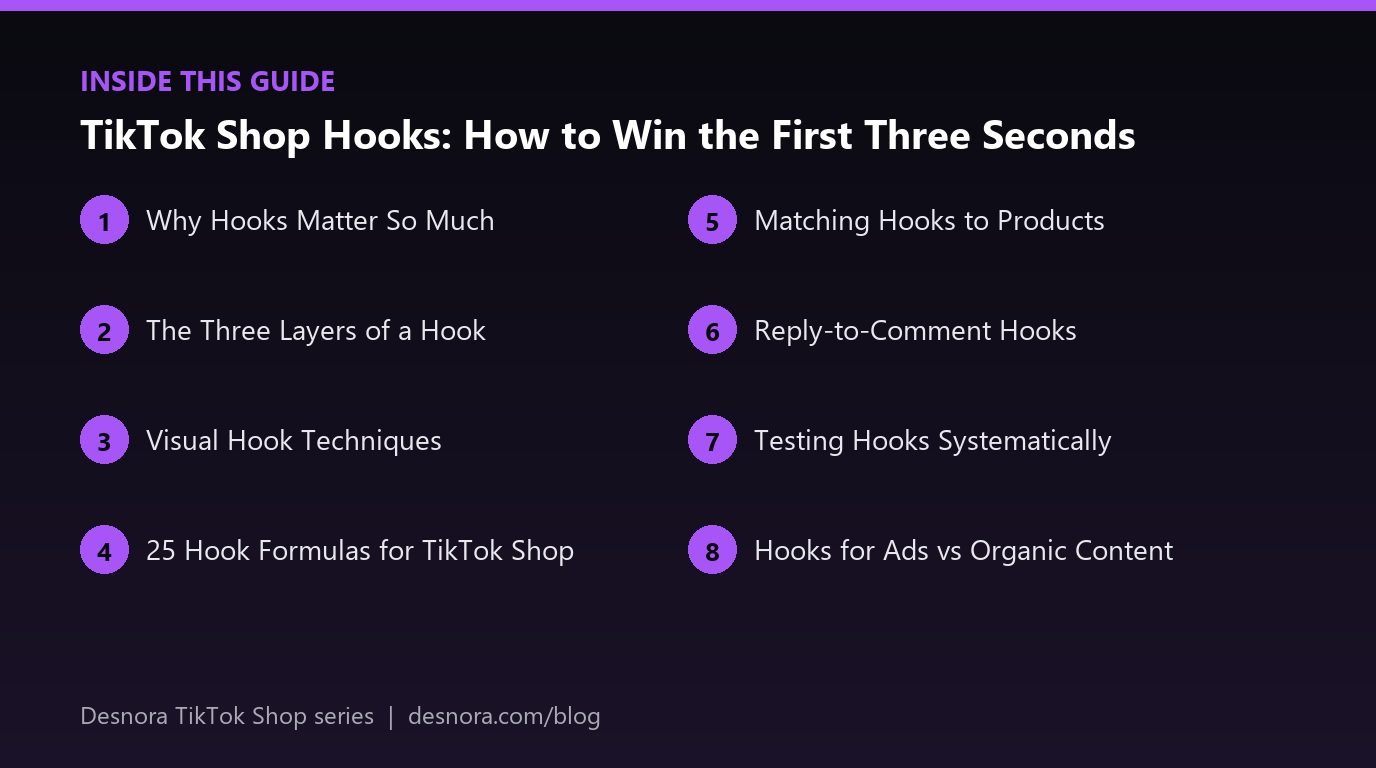
Great hooks are not just clever lines. They combine what the viewer sees, hears and reads at the very start of a video into one moment that creates curiosity or recognition. This guide explains how hooks work, shares 25 formulas you can adapt and shows how to test hooks systematically so you can find winners faster.

Why Hooks Matter So Much
TikTok's recommendation system tests each video with an initial audience and watches how they respond. Videos that hold attention, get rewatched and drive engagement are shown to more people. A weak hook leads to quick swipes, which signals low interest, and distribution stalls. A strong hook keeps people watching long enough for the rest of your video to work.
For TikTok Shop, hooks also filter the audience. A hook that speaks directly to a specific problem attracts people who have that problem, who are more likely to buy. Broad, attention-grabbing hooks may get views but fewer sales. The best hooks combine stopping power with relevance.
The Three Layers of a Hook
Every effective hook works on three layers at once:
- Visual hook: what appears on screen in the first frame, such as an unusual action, a dramatic result, a close-up or movement.
- Verbal hook: the first words spoken, ideally a statement or question that creates curiosity.
- Text hook: on-screen text that reinforces the message for viewers watching without sound.
When all three align, the hook is far more powerful. A creator saying "this saved my morning routine" while holding up the product with text reading "5-minute hair fix" is clearer than any one element alone.
Visual Hook Techniques
The first frame matters as much as the first words. Effective visual hooks include:
- Start mid-action: open while something is already happening, such as pouring, cutting, applying or cleaning.
- Show the result first: the finished look, the clean surface or the perfectly organised drawer.
- Use movement toward the camera: pushing the product toward the lens creates instant focus.
- Unexpected visuals: something unusual or surprising that makes viewers wonder what is happening.
- Extreme close-ups: texture, detail or a satisfying moment shown up close.
Avoid slow intros, logos or a creator saying "hi guys" before getting to the point. Every frame before the hook is a chance for viewers to leave.
25 Hook Formulas for TikTok Shop
Use these as starting points and adapt the wording to your product and audience:
- "If you struggle with [problem], you need to see this."
- "I can't believe this only costs [price range]."
- "Stop scrolling if you [specific situation]."
- "This is the [product] everyone keeps asking me about."
- "I've tried every [category], and this is the only one I kept."
- "Here's why my [result] looks like this."
- "Nobody talks about this [category] hack."
- "Three reasons I'll never go back to [old way]."
- "I was today years old when I found out [surprising fact]."
- "Watch what happens when I [action]."
- "Things that just make sense: [product]."
- "POV: you finally found a [product] that actually [benefit]."
- "Don't buy [category] until you watch this."
- "My [family member] laughed at me for buying this. Now they want one."
- "Rating viral [category] products so you don't have to."
- "I tested this for 30 days. Here's what happened."
- "The [product] that fixed my [problem] in [time]."
- "You're using your [item] wrong."
- "If I could only keep one [category] product, it'd be this."
- "Is this the most underrated [category] on TikTok Shop?"
- "Small things that made my [room or routine] so much better."
- "Replying to [comment]: yes, it really works. Here's proof."
- "This is your sign to finally [desired action]."
- "[Price] vs [higher price]: can you tell the difference?"
- "I bought this because of TikTok, and honestly..."
Be careful with claims inside hooks. Statements like "fixed" or "cured" can create policy issues in health and beauty categories. Keep promises realistic and supportable.
Matching Hooks to Products
Different products need different hook styles:
- Problem-solving products: lead with the problem the viewer recognises.
- Visually impressive products: lead with the demo or result.
- Value products: lead with price surprise or comparison.
- Trend products: lead with social proof and curiosity.
- Gift products: lead with the recipient's reaction or a "gift idea" angle.
Pair your hook with a script framework from our guide to TikTok Shop video scripts so the rest of the video delivers on the promise.
Reply-to-Comment Hooks
Replying to a viewer comment with a video is one of TikTok's most effective native formats. The comment appears on screen as a sticker, instantly giving context and social proof. Use comments that ask questions, express doubt or request a demonstration. "Does it really work on thick hair?" is a perfect prompt for a demonstration video that addresses exactly that concern.
These videos also show viewers that the brand or creator listens, which builds trust and encourages more comments, feeding a cycle of content ideas.
Testing Hooks Systematically
The fastest way to improve hook performance is structured testing. Keep the body of a video identical and swap only the first few seconds. Post three to five variations and compare:
- Two-second and six-second view rates: how many viewers kept watching past the hook.
- Average watch time: whether the hook attracted the right viewers.
- Product clicks and orders: whether the hook drove buyers, not just viewers.
Once you identify a winning hook, reuse it across creators and in ads. Our guide to TikTok Shop ads explains how to scale winning creative, and our analytics guide covers the metrics in more detail.
Hooks for Ads vs Organic Content
Hooks behave a little differently in paid placements. Organic viewers who follow you or a creator have some context and goodwill. Ad viewers do not. They are seeing your content for the first time, often in the middle of entertainment, and their instinct is to swipe past anything that looks like an advert.
For ads, prioritise hooks that feel native: a person speaking directly to camera, a reply to a comment, a reaction or an in-progress demonstration. Avoid opening with logos, polished brand graphics or anything that signals "advertisement" before the viewer is interested. Problem-led hooks also work particularly well in ads because they qualify the audience immediately, reducing wasted spend on viewers who will never buy.
When a hook performs well organically, test it in ads as well. Organic winners often become paid winners, and the reverse is also true: an ad hook that drives strong click-through can inspire new organic content.
Seasonal and Trend Hooks
TikTok moves with trends, sounds and seasonal moments, and hooks that tap into them can gain extra reach. A gift-guide hook in the weeks before the holidays, a "summer essentials" angle in spring or a playful take on a trending format can all lift performance. The key is relevance: the trend should connect naturally to your product rather than being forced.
Keep a calendar of seasonal moments that matter to your category and plan hook variations in advance. Our Q4 holiday playbook covers the busiest season in detail. Trend-based hooks have a short shelf life, so move quickly and retire them once the trend fades.
Building a Hook Library
Keep a shared document of hooks that worked, organised by product and angle, with links to the videos and their key metrics. Add hooks from competitors and creators in your category that clearly performed well, rewriting them for your product rather than copying. Share the library in creator briefs so every new video starts with proven openings. Over time, this library becomes one of your most valuable creative assets.
Common Hook Mistakes
- Starting with a greeting, logo or slow pan before anything interesting happens.
- Using hooks that are clickbait and unrelated to the product, attracting the wrong viewers.
- Text that is too small, too long or covered by TikTok's interface elements.
- Saying the same hook as everyone else in the category without a fresh twist.
- Over-promising results that the product cannot deliver.
Hooks are the front door of your TikTok Shop content. Desnora develops hook libraries, creator briefs and shoppable video content for brands. See our TikTok Shop services, browse our portfolio or contact us for a content audit.
Frequently Asked Questions
What is a hook in a TikTok video?
A hook is the opening moment of a video, usually the first one to three seconds, designed to stop viewers from scrolling by creating curiosity, recognition or surprise.
How long should a TikTok hook be?
Most effective hooks land within the first one to three seconds. The key message should be clear before a viewer has time to swipe away.
Should hooks be spoken or written on screen?
Both. Combine a strong visual, a spoken line and on-screen text so the hook works for viewers watching with or without sound.
How many hooks should I test per product?
Test at least three to five hooks per product, keeping the rest of the video the same, so you can identify which opening drives the most views and sales.
Can I reuse hooks from other creators?
You can adapt proven hook structures, but rewrite them for your product and avoid copying another creator's content directly. Original twists perform better and avoid copyright issues.