"How much should I spend on TikTok ads?" is one of the most common questions from TikTok Shop sellers, and there is no single number that fits every brand. Spend too little and campaigns never gather enough data to optimise. Spend too much too soon and you burn cash on creative and products that are not ready. The right budget depends on your margins, goals, creative supply and cash position.
This guide gives you a practical framework for setting, testing and scaling a TikTok Shop ads budget. Minimum budgets and campaign options change over time, so check current settings in TikTok Ads Manager and Seller Center.

Start With Your Margins
Every budget decision starts with unit economics. Calculate your contribution margin per order after product cost, platform fees, affiliate commissions, shipping and average promotions. Your break-even return on ad spend (ROAS) is roughly 1 divided by your contribution margin as a percentage of the sale price. If you keep 40% before ads, break-even ROAS is about 2.5. Our fees guide shows how to calculate margin.
Knowing break-even tells you what performance you need for ads to be profitable and how much room you have to invest in growth.
Decide Your Goal
- Testing: learning which products and creative work, accepting lower efficiency.
- Launching: building initial sales and reviews for a new product, sometimes below break-even.
- Scaling: growing sales profitably on proven products and creative.
- Peak campaigns: maximising volume during major sale events.
Each goal justifies a different budget level and return target.
Setting a Starting Budget
A starting budget should be large enough for campaigns to gather meaningful data, often enough to generate a reasonable number of orders per week, and small enough that losing it would not harm the business. Many sellers start with a modest daily budget on one or two proven products, using their best organic and creator videos. Respect any platform minimums.
Avoid spreading a small budget across many products and campaigns; concentrate it where you are most likely to see results.
Testing Budget vs Scaling Budget
Separate your budget into testing and scaling. A testing budget explores new creative, products or audiences with small amounts. A scaling budget backs proven winners with larger amounts. Many brands keep a fixed share for testing even when scaling, so they always have new winners ready when current creative fatigues. Our testing framework explains how to design tests.
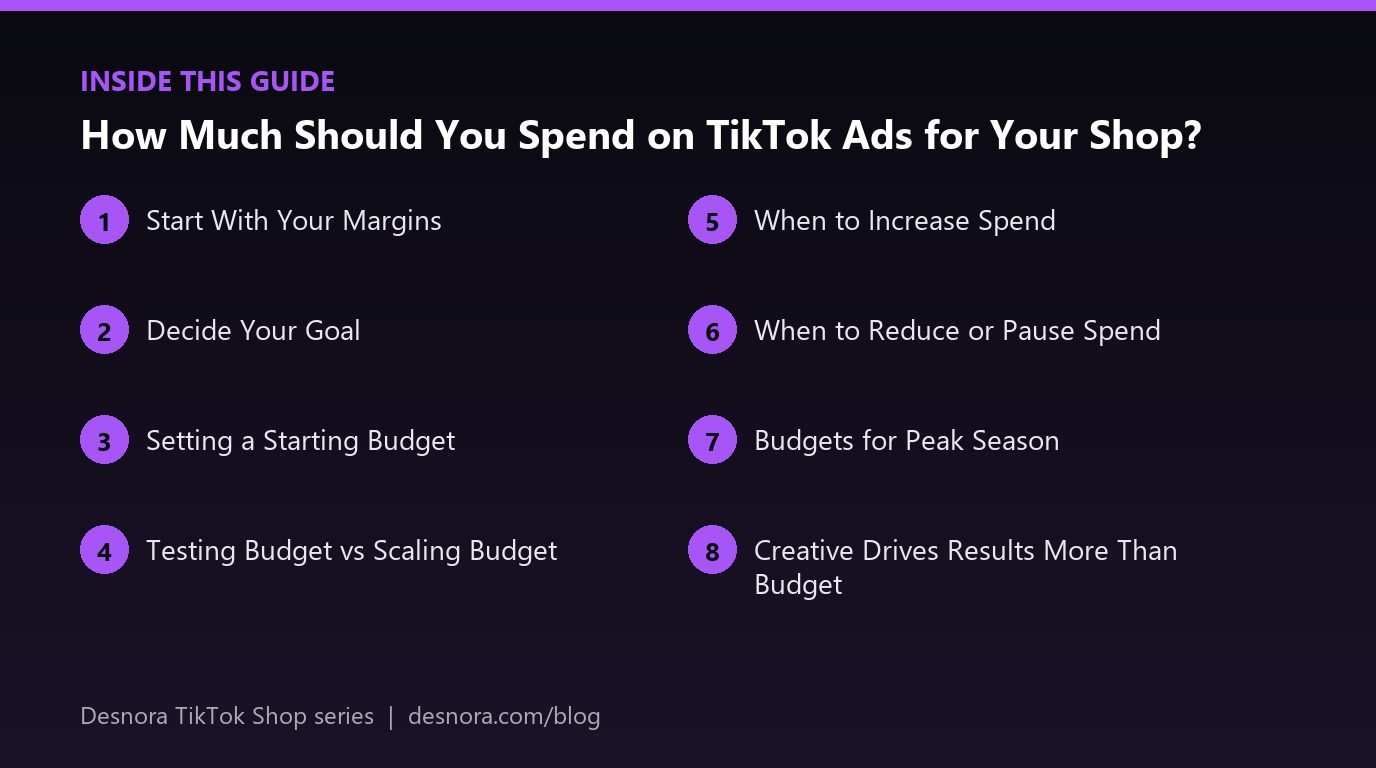
When to Increase Spend
Increase budget when a campaign consistently performs at or above your target return over several days, you have enough creative to avoid fatigue and you have inventory to support more sales. Increase gradually, for example by a moderate percentage every few days, rather than doubling overnight, which can unsettle performance. Our ads guide covers scaling.
When to Reduce or Pause Spend
Reduce spend when return falls below target for a sustained period, creative is clearly fatigued, stock is running low or product pages have issues such as new negative reviews. Diagnose before cutting: sometimes fresh creative or a better offer fixes performance.
Budgets for Peak Season
During major campaigns and Q4, competition and costs rise, but conversion often improves too. Plan higher budgets in advance, prepare extra creative and ensure stock and fulfillment can handle increased volume. Our Q4 playbook and Black Friday guide cover peak planning.
Creative Drives Results More Than Budget
Doubling budget rarely fixes weak creative. Strong videos with proven hooks are the biggest driver of ad performance. Invest in a steady supply of creative from brand content, creators and Spark Ads. Our Spark Ads guide explains how to use creator videos.
Measuring Ad Spend Properly
Look at campaign-level ROAS and cost per order, but also at blended results: total shop revenue against total ad spend. Ads can lift organic and affiliate sales beyond what is directly attributed. Review weekly and make decisions on trends, not single days. Our analytics guide covers measurement.
Cash Flow and Ad Spend
Ad spend is paid before revenue from resulting orders settles. Make sure your cash flow can support ad spend, especially when scaling. Our cash flow guide explains timing.
Budgeting for a Product Launch
New products have no sales history or reviews, so ads often perform below break-even at first. Many brands accept a short period of lower efficiency during launch to build initial sales, reviews and data, then tighten targets once the product proves itself. Set a defined launch budget and timeframe, and review results before continuing. Our launch plan explains timing.
Budget by Product Margin
Products with higher margins can support higher ad spend per order. Consider grouping products by margin and setting different return targets for each group. This prevents low-margin products from consuming budget that would be more profitable elsewhere.
Ad Spend as a Share of Revenue
Some brands plan ad spend as a percentage of revenue, adjusting the share based on goals and margins. This simple rule helps keep spend proportional as the business grows, though it should always be checked against actual returns rather than followed blindly.
Budgeting for Creative Production
Ads need a continuous supply of creative, which has its own costs: UGC creator fees, editing time and product samples. Include creative production in your overall ads budget. Underfunding creative while increasing media spend is a common reason for declining performance.
Budgeting for LIVE Promotion
If you run LIVE streams, consider a separate budget for promoting them. LIVE promotion can bring new viewers into streams, especially early in a session. Measure GMV per hour against LIVE promotion spend to judge whether it pays off. Our LIVE selling guide covers more.
Reviewing Budgets Monthly
At the end of each month, review spend by campaign and product, compare results with targets and decide where to increase, hold or reduce. Monthly reviews keep budgets aligned with performance and business goals.
Small Business Budgets
Small businesses can still benefit from ads with modest budgets. Focus on a single proven product, use your best organic video and set a daily budget you can sustain for several weeks. Treat early spend as learning and scale only when results justify it. Our small business guide covers prioritisation.
Agency and Management Costs
If an agency or freelancer manages your ads, include their fees in your calculations. Compare total cost, media plus management, against the profit ads generate. A good manager should improve efficiency enough to cover their cost; review this regularly.
Common Budgeting Mistakes
- Setting budgets without knowing break-even ROAS.
- Spreading small budgets across too many campaigns.
- Scaling before creative and stock are ready.
- Making large daily changes that reset learning.
- Ignoring blended results.
Desnora plans and manages TikTok Shop ad budgets for brands. Explore our TikTok Shop services and advertising services, or request an audit.
Frequently Asked Questions
How much should I spend on TikTok Shop ads?
Enough for campaigns to gather data and generate meaningful orders, based on your margins and cash, then scale as results prove profitable.
What is break-even ROAS?
The return on ad spend at which ads neither make nor lose money, roughly 1 divided by your contribution margin percentage.
Should I start with a small TikTok ads budget?
Start modestly on one or two proven products with your best creative, concentrating budget rather than spreading it thin.
When should I increase my TikTok ad budget?
When performance is consistently above target, you have enough creative and stock supports more sales. Increase gradually.
Why are my TikTok ads not profitable?
Common causes are weak creative, low margins, poor product pages and unrealistic targets.
Should I spend more during Black Friday?
Often yes, with planned budgets, extra creative and stock ready, since conversion usually rises during peaks.
Is daily or campaign budget better?
It depends on your setup. The key is giving campaigns enough budget to learn and avoiding frequent large changes.
How much should I keep for testing?
Many brands reserve a fixed share of budget for testing new creative and products, even while scaling winners.
Does more budget fix bad ads?
Rarely. Creative quality drives performance far more than budget size.
How do I measure if ad spend is working?
Track campaign ROAS and cost per order alongside blended shop revenue against total ad spend.
Should I spend more during a product launch?
Many brands accept lower efficiency for a set launch period to build sales and reviews, then tighten targets.
Should creative production be part of my ad budget?
Yes. Ads need constant fresh creative, so include UGC fees, editing and samples in your budget.
Can small businesses afford TikTok ads?
Yes, with a modest, sustainable budget focused on one proven product and your best video, scaled only when results justify it.
Should I include management fees in my ad budget?
Yes. Compare total cost, media spend plus management, against the profit ads generate.
How long should I test a new ad budget?
Give campaigns at least a week or two of steady spend before judging, avoiding large changes during that time.
Should all products get the same ad budget?
No. Allocate more to proven, higher-margin products and keep smaller test budgets for new ones.